Same Average Return, Wildly Different Outcomes: The Hidden Danger of When Your Gains and Losses Occur
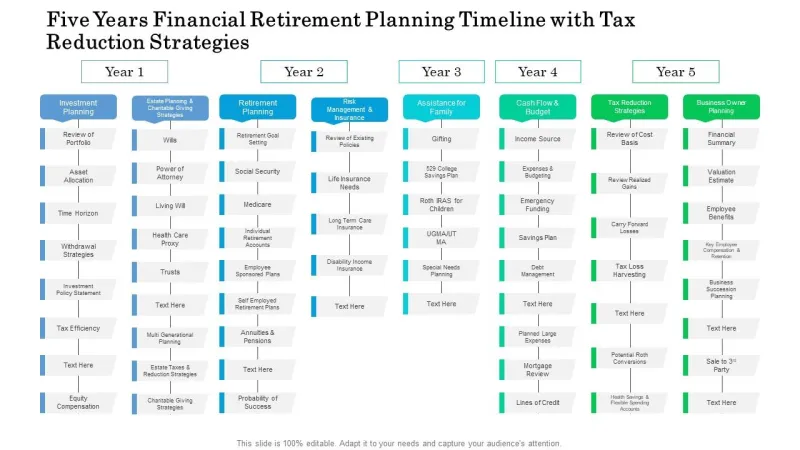
Photo: retirement portfolio investment timeline planning chart, via www.slidegeeks.com
Most investors spend the better part of their working lives fixated on one number: average annual return. Beat the S&P 500, they reason, and retirement security is guaranteed. It is a logical assumption, but it contains a critical blind spot. The order in which those returns arrive can matter just as much as the returns themselves—and in some scenarios, it matters far more.
This is the essence of sequence of returns risk, and understanding it may be one of the most important steps you take toward building a resilient retirement strategy.
Two Investors, One Average, Two Destinies
Consider a straightforward illustration. Investor A and Investor B each retire at 65 with $1,000,000. Both experience an average annual return of 8% over a 20-year retirement. Both withdraw $60,000 per year to cover living expenses. On paper, their situations look identical.
Investor A experiences strong gains in the early years of retirement—12%, 15%, and 10% in the first three years—before a significant market downturn arrives in years seven through nine. Investor B faces the opposite sequence: a brutal bear market strikes in years one through three, followed by a prolonged recovery and strong gains thereafter.
By year 20, Investor A's portfolio has grown sufficiently during the early withdrawal years to absorb the later losses. Investor B, however, was forced to sell a much larger percentage of shares during the downturn simply to meet withdrawal needs. Those shares were never available to participate in the subsequent recovery. Investor B may run out of money a decade before Investor A—despite both experiencing the exact same 8% average return over the same period.
This is not a hypothetical quirk. It is a mathematical reality with profound implications for anyone approaching or living in retirement.
Why Withdrawals Amplify the Problem
During the accumulation phase—when you are still working and contributing to your portfolio—sequence of returns risk is relatively muted. A market decline early in your career is actually an opportunity to purchase shares at lower prices, and the decades ahead allow the portfolio to recover fully.
The calculus changes completely once withdrawals begin. At that point, selling assets to fund living expenses during a downturn locks in losses permanently. The portfolio's remaining balance is smaller, which means fewer shares are available to benefit from the eventual recovery. This compounding negative effect is sometimes called the "dollar cost ravaging" problem—the inverse of dollar cost averaging.
Historical data reinforces this concern. Investors who retired in 1966, for example, faced a decade of stagflation, rising interest rates, and lackluster equity returns right at the outset of their retirement. Even those who held diversified portfolios with reasonable average returns over the full period saw their purchasing power eroded significantly faster than retirees who began their drawdown phase in 1982, just before one of the longest bull markets in American history.
Stress-Testing Your Portfolio Against Unfavorable Sequences
The good news is that sequence of returns risk is manageable. The first step is acknowledging that your retirement plan must account for bad luck in timing, not just favorable average outcomes. Here are several strategies that financial planners and sophisticated investors use to build that resilience.
Establish a Cash or Short-Term Reserve
Maintaining one to three years of living expenses in cash equivalents or short-term Treasury instruments allows you to fund withdrawals during a market downturn without selling equities at depressed prices. This buffer gives your stock holdings time to recover before you need to liquidate them.
Adopt a Dynamic Withdrawal Strategy
Rather than withdrawing a fixed dollar amount each year, consider adjusting your withdrawals based on portfolio performance. During strong market years, you may withdraw slightly more. During downturns, a modest reduction in spending—even 5% to 10%—can meaningfully extend the life of your portfolio. This approach requires flexibility but offers a powerful hedge against adverse sequences.
Incorporate Guaranteed Income Sources
Social Security, annuities, and pension income reduce your dependence on portfolio withdrawals during any given market environment. The less you are forced to sell in a down market, the less damage an unfavorable sequence can inflict. Delaying Social Security to age 70, where benefits increase by approximately 8% per year beyond full retirement age, is one of the most effective strategies available to American retirees.
Rebalance Strategically
A disciplined rebalancing process—selling assets that have appreciated and reallocating to those that have declined—naturally creates a mechanism for selling high and buying low. It also ensures that your asset allocation does not drift so far into equities that a single bad sequence could permanently impair your portfolio.
Model Multiple Scenarios, Not Just the Average
When projecting retirement outcomes, avoid relying solely on average return assumptions. Run Monte Carlo simulations or historical sequence analyses that account for a range of return orderings. Many financial planning tools available through major brokerage platforms allow investors to test their portfolios against the worst historical 30-year sequences, including the 1929–1959 period and the stagflation era of the 1970s.
The Accumulation Phase Is Not Immune
While sequence risk is most acute during drawdown, it is worth noting that the years immediately preceding retirement also carry elevated exposure. A severe market decline in the five years before you stop working compresses your portfolio at precisely the moment when your balance is at its highest and your ability to recover through continued contributions is diminishing.
This is why many financial advisors recommend gradually reducing equity exposure as retirement approaches—not because stocks are inherently dangerous, but because the cost of a poorly timed sequence is asymmetric. You have less time and fewer options to recover.
Building a Blueprint That Accounts for Timing
At The Stock Market Blueprint, we believe that investment education must go beyond average returns and back-tested performance figures. True financial literacy requires understanding the structural risks embedded in when you invest, when you withdraw, and how the market's mood at those critical moments shapes your long-term outcome.
Sequence of returns risk is not a reason to avoid equities or to abandon long-term investing. It is a reason to build a portfolio with the structural flexibility to weather adverse conditions—one that does not require perfect timing to survive, only thoughtful preparation.
The investors who retire with confidence are rarely those who simply earned the highest returns. They are the ones who built portfolios resilient enough to endure whatever sequence the market delivered—and planned accordingly.