Compounding on Autopilot: A Step-by-Step Guide to Growing $5,000 Into a Half-Million With Dividend Reinvestment
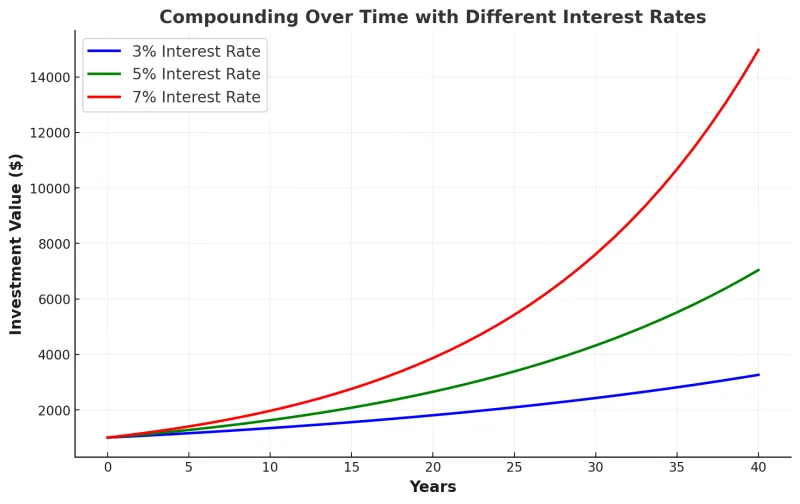
Photo: dividend growth investing compound interest chart long term wealth, via cdn.chime.me
Why Most Investors Leave Money on the Table
When investors think about stock market returns, they typically focus on price appreciation—the difference between what they paid for a share and what it trades for today. That instinct is understandable, but it tells only part of the story. A growing body of research suggests that dividend reinvestment has historically accounted for a significant portion of the total long-term returns generated by the S&P 500. Ignoring that income stream is, in effect, leaving a meaningful percentage of your potential wealth uncollected.
The concept behind a Dividend Reinvestment Plan—commonly referred to as a DRIP—is straightforward: rather than receiving dividend payments as cash, those distributions are automatically used to purchase additional shares of the same stock or fund. Over time, those additional shares generate their own dividends, which purchase still more shares. The cycle is self-reinforcing, and given enough time, it becomes remarkably powerful.
The Mathematics of Compounding: Running the Numbers
Consider a hypothetical investor who places $5,000 into a dividend-paying stock with an initial yield of 3.5% and an average annual total return—including price appreciation and dividend growth—of approximately 9%. Without reinvestment, the dividends generate a fixed income stream but contribute nothing to share accumulation. With full reinvestment, however, the effective return compounds annually.
Using a standard compound growth formula, $5,000 growing at 9% annually for 30 years yields roughly $66,000. That figure alone is respectable. But when dividend growth is layered in—many established U.S. companies have increased their payouts by 5% to 8% per year for decades—the trajectory shifts considerably. Modeling a scenario in which the dividend yield climbs incrementally alongside reinvestment can push that same initial $5,000 toward the $500,000 range over a 30-year horizon, particularly when additional periodic contributions are made along the way.
The lesson here is not that $500,000 is guaranteed. It is that the structure of reinvestment—allowing each dollar of income to generate its own future income—creates a fundamentally different growth curve than passive income collection.
Historical Proof: Companies With Decades of Dividend Growth
The United States equity market offers a well-documented group of companies known as Dividend Aristocrats—S&P 500 members that have raised their dividends for at least 25 consecutive years. Names such as Johnson & Johnson, Procter & Gamble, and Coca-Cola have rewarded patient, reinvesting shareholders through multiple recessions, market corrections, and periods of economic uncertainty.
Procter & Gamble, for instance, has paid uninterrupted dividends since 1890 and has raised its payout for more than 65 consecutive years. An investor who purchased shares in the early 1990s and enrolled in a DRIP would have seen their share count multiply substantially—not through additional purchases, but purely through reinvestment. The compounding effect in such cases is not theoretical; it is a documented historical outcome.
Diversifying across sectors—consumer staples, healthcare, utilities, and select financials—can further reduce the risk that a single company's dividend cut derails the entire strategy.
Setting Up a DRIP Account: A Practical Walkthrough
The mechanics of establishing a DRIP account are more accessible today than at any point in investing history. Here is a step-by-step framework:
Step 1: Open a brokerage account that supports automatic dividend reinvestment. Most major U.S. brokerages—including Fidelity, Charles Schwab, and Vanguard—allow investors to enable automatic dividend reinvestment at the account level or on a stock-by-stock basis at no additional cost.
Step 2: Select your initial positions. Prioritize companies or funds with a verifiable track record of dividend payments and growth. Dividend yield alone is not sufficient; a high yield can sometimes signal financial distress rather than generosity. Look for payout ratios below 70%, consistent free cash flow, and a history of annual increases.
Step 3: Enable the DRIP setting. Within your brokerage dashboard, locate the dividend reinvestment option and activate it for each eligible holding. Some brokerages apply the setting universally; others require stock-by-stock selection.
Step 4: Automate additional contributions. The compounding effect accelerates meaningfully when supplemented by regular deposits. Even $100 to $200 per month added to your reinvesting positions can substantially alter the long-term outcome.
Step 5: Review annually, not obsessively. DRIP investing is a long-horizon strategy. Quarterly check-ins to verify that dividend growth remains intact and that fundamentals have not deteriorated are sufficient. Reacting to short-term price volatility undermines the strategy's core logic.
Common Pitfalls That Erode Compounding Gains
Several behavioral and structural mistakes cause investors to fall short of their compounding potential.
Chasing yield over quality. A stock yielding 10% may appear attractive, but unsustainably high yields frequently precede dividend cuts. When a cut occurs, the share price typically falls simultaneously, delivering a double blow to the DRIP investor.
Neglecting tax-advantaged accounts. Dividends received in a taxable brokerage account are subject to federal taxation, which reduces the amount available for reinvestment. Holding DRIP positions within a Roth IRA or traditional IRA eliminates this drag, allowing the full dividend to compound unimpeded.
Abandoning the strategy during downturns. Market corrections cause dividend reinvestment to purchase more shares at lower prices—a mechanically advantageous outcome for long-term investors. Selling during these periods not only locks in losses but eliminates the accelerated accumulation that downturns quietly enable.
Concentrating in a single sector. Utilities and consumer staples are reliable dividend payers, but a portfolio confined to one sector carries sector-specific risk. A balanced approach across four to six dividend-paying sectors provides more durable compounding over a multi-decade horizon.
Building Your Blueprint
Dividend reinvestment is not a shortcut or a speculation. It is a disciplined, mathematically grounded approach to wealth accumulation that rewards patience above all else. The investors who benefit most are those who establish the structure early, automate the process, and resist the temptation to intervene unnecessarily.
For aspiring investors willing to commit to a 20- or 30-year horizon, a well-constructed DRIP portfolio represents one of the clearest pathways from a modest starting position to genuine financial independence. The blueprint is straightforward. The execution requires only consistency.