Same 8% Return, $200,000 Apart: The Hidden Force That Separates Wealthy Retirees From Struggling Ones
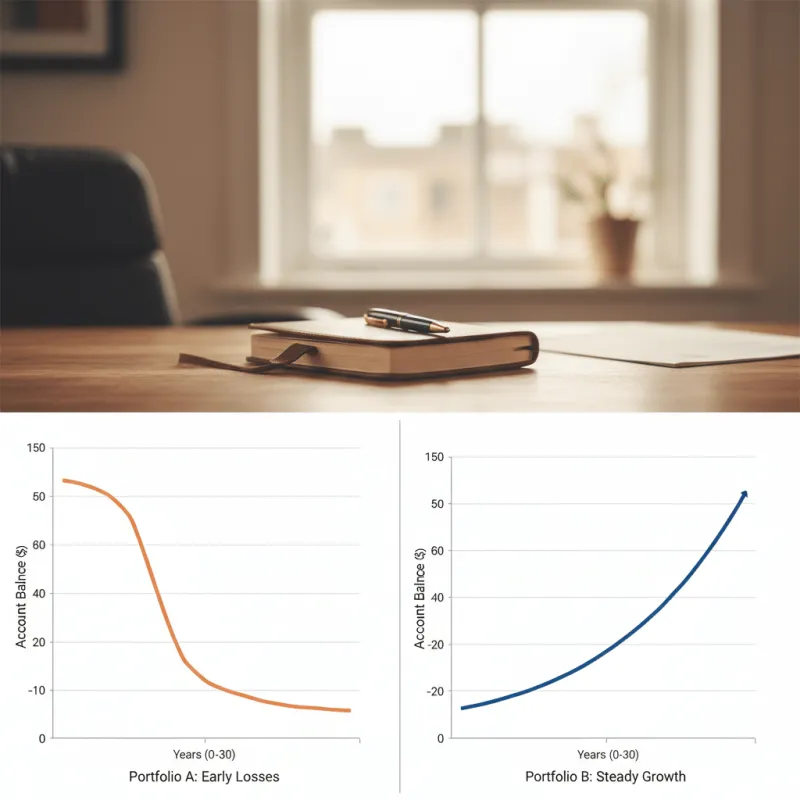
Photo: two investors comparing retirement portfolio growth charts on laptop, via tdwealth.net
Most investors measure success by a single number: their average annual return. If the brokerage statement shows 8% annualized over two decades, the assumption is that any other investor who also earned 8% annualized must have arrived at the same destination. That assumption is dangerously wrong.
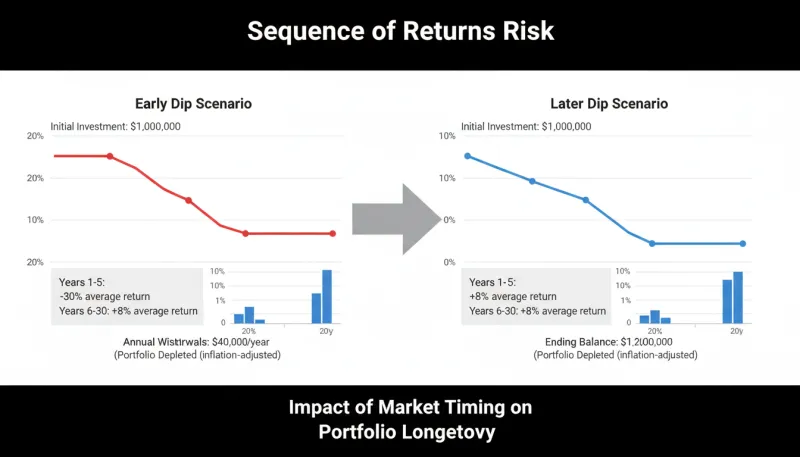
The phenomenon responsible for this gap is known as sequence of returns risk — or, more precisely during the accumulation phase, the sequence of returns opportunity. Whether the market's best years arrive early or late in your investing timeline has an outsized effect on the final value of your portfolio, even when the long-run average is mathematically identical. For investors building wealth toward retirement, this is not a theoretical curiosity. It is a structural reality that demands a deliberate strategic response.
A Tale of Two Portfolios
Consider two investors — call them Marcus and Diana — each contributing $10,000 per year for 25 years into a diversified equity portfolio. Over that quarter-century, both earn an annualized return of exactly 8%. The only difference is the order in which annual returns occur.
Marcus begins investing in a bull market. His first decade delivers strong double-digit gains. His second decade is marked by flat to modestly negative years. His final five years recover.
Diana begins in a flat, choppy market. Her first decade produces modest or negative returns. Her second and third decades, however, deliver strong, sustained gains.
Run the numbers with realistic return sequences, and the outcome is striking. Marcus, who benefited from early gains, may retire with a portfolio worth $50,000 to $200,000 less than Diana — despite both achieving the same 8% annualized figure over the full period.
This is not a rounding error. It is the mathematics of compounding colliding with the reality of ongoing contributions.
Why the Order of Returns Changes Everything
The core mechanics are straightforward once you see them. When markets rise early in your investing life, your account balance is small. A 30% gain on a $15,000 portfolio adds $4,500. Impressive in percentage terms, but modest in absolute dollars.
When markets rise late in your investing life, your account balance is large. A 30% gain on a $400,000 portfolio adds $120,000. The same percentage return produces an outcome that is 26 times greater in dollar terms.
This means that for accumulating investors who contribute regularly, late bull markets are more valuable than early ones. Every dollar of gain applied to a larger base has exponentially greater impact on final wealth.
Conversely, early bear markets — while psychologically painful — do comparatively little damage to long-term outcomes when your balance is small. A 30% loss on $15,000 costs you $4,500. The same percentage loss on $400,000 costs $120,000. The asymmetry works both ways.
This is the paradox: the investor who suffers early losses and earns late gains often finishes ahead of the investor who enjoyed early gains and suffered late losses, even when their annualized returns are identical.
The Contribution Timing Effect
Regular contributions amplify this dynamic in a way that lump-sum investors do not experience as acutely. When you contribute $10,000 per year through a down market, you are purchasing more shares at lower prices. Those shares then benefit from every subsequent year of growth. Your contributions are, in effect, working harder during periods of market weakness.
This is the mechanical basis for dollar-cost averaging — not merely a psychological comfort tool, but a genuine wealth-building engine when markets are volatile. Investors who pause contributions during downturns, waiting for conditions to improve, inadvertently forfeit the very advantage that sequence-of-returns mathematics offers them.
The blueprint for accumulating investors is therefore counterintuitive: a rough start to your investing career, paired with disciplined ongoing contributions, can be a structural advantage rather than a setback.
Rebalancing as a Return-Sequencing Tool
Beyond contribution timing, systematic rebalancing is one of the most underappreciated mechanisms for managing sequence risk. When equities decline sharply, a rebalancing strategy directs capital from bonds or cash into stocks at depressed prices — effectively automating the "buy low" behavior that most investors find emotionally difficult to execute.
The result is a portfolio that continuously harvests the benefit of low prices during downturns and locks in gains during rallies. Over long periods, disciplined rebalancing has been shown in academic research to add between 0.5% and 1.5% in annualized return compared to a static allocation — not through market timing, but through systematic response to price movements.
For investors in their accumulation years, quarterly or annual rebalancing tied to contribution decisions creates a compounding advantage that operates independently of which direction markets move next.
What This Means for Your Strategy Right Now
The practical implications of sequence-of-returns dynamics are worth translating into concrete action steps.
Do not reduce or suspend contributions during bear markets. The instinct to pause investing when portfolios decline is understandable but counterproductive. Bear markets during accumulation are when contributions generate the most long-term value.
Automate your investment schedule. Removing emotion from the contribution process ensures that you buy through downturns rather than retreating from them. Employer-sponsored 401(k) plans and automatic brokerage transfers are structural tools that enforce this discipline.
Maintain a rebalancing policy and follow it. Establish target allocations and a threshold — many advisors suggest rebalancing when any asset class drifts more than five percentage points from its target — and execute mechanically rather than emotionally.
Shift focus as retirement approaches. Sequence risk does not disappear at retirement; it transforms. The years immediately preceding and following your retirement date are when large losses cause the most permanent damage, because you no longer have decades of contributions to rebuild your base. This is the phase where sequence risk most closely resembles the threat described in withdrawal-stage discussions. Gradually reducing equity concentration in the five to ten years before retirement is a recognized method of managing this transition.
The Blueprint Insight
Average returns are a useful shorthand, but they conceal the machinery that actually determines how much wealth you accumulate. Two investors can follow identical strategies, select identical funds, and earn identical long-run averages — and still arrive at retirement with portfolios separated by hundreds of thousands of dollars, depending on nothing more than the calendar.
The investors who understand this reality do not simply accept sequence risk as fate. They construct portfolios, contribution habits, and rebalancing disciplines that position them to benefit from the paradox rather than fall victim to it. They recognize that a turbulent early decade is not a sign of failure — it is the market offering discounted shares to investors patient enough to keep buying.
Building wealth is not only about the return you earn. It is about when you earn it, how you respond to it, and whether your strategy is designed to compound the advantage that market volatility quietly offers to those who know where to look.